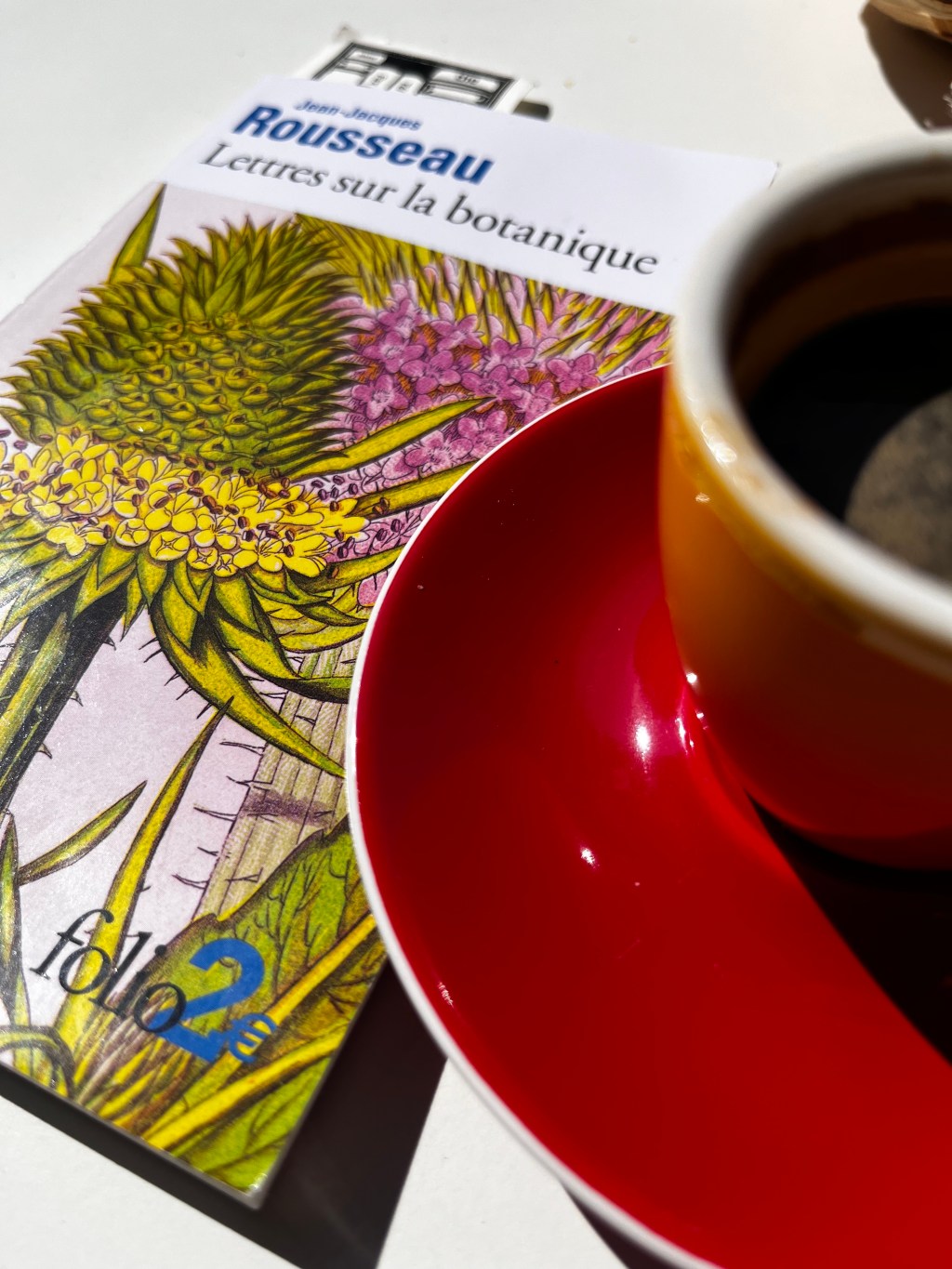
Rousseau’s “Lettres sur la Botanique” is not the kind of book I’d normally read. It’s non-fiction, and it’s a book that looks at the natural world through a scientific lens, so neither the genre, nor the subject were up my alley. Yet, I found myself drawn to the book at the boutique of the Musée Bourdelle. Perhaps it was the after-effect of the hour I had just spent in the garden of the museum, that made me more open to the subject. Perhaps it was the size of the book, that made me think that it would be ideal for my metro reading. Slim enough to fit in my purse, it would be a good change from my usual reading.
Whatever the reason, I’m glad I picked up the book. Through these letters addressed to his cousin, Rousseau took me on a botanical journey in the world of flowering plants. I was immediately struck by the eloquence of the prose and his keen observations, as he delved into the beauty and significance of botany. His thesis that studying botany and the natural world can help individuals reconnect with nature and gain a better understanding of the world around them comes out clearly in the letters. An extension of his interest in the relation between the natural world and human condition, the letters also offer an insight into the Enlightenment era’s fascination with science and the natural world.
Though incredibly niche, I would recommend the book to everyone, irrespective of their interest in Rousseau, the Enlightenment era, or botany. Rousseau provides very detailed descriptions, so the terms might seem challenging at first, but if you can move past that hurdle, the descriptions reveal the beauty and intricacy of plants. In fact, Thomas Martyn who first translated the letters into English said that “the letters were not meant for reading while sitting in an easy chair; rather they were directed at readers with a plant in their hand.” The book would, of course, be particularly interesting if you’re somebody who appreciates nature and its beauty – and I think that’s what kept me captivated, as I devoured letter after letter (not that there are that many).
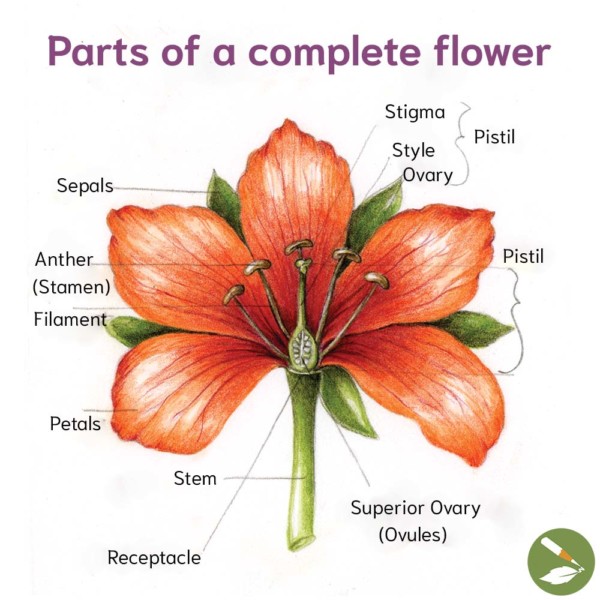
Certain descriptions, like this one about the reproductive organs of flowers took me back to Biology classes when we studied the plant world, and had to make diagrams of the parts of a flower and their functions.
{English translation below this excerpt from Letter 1)
Prenez un lis. Je pense que vous en trouverez encore aisément en pleine fleur. Avant qu’il s’ouvre, vous voyez à l’extrémité de la tige un bouton oblong verdàtre, qui blanchit à mesure qu’il est prêt à s’épanouir; et quand il est tout à fait ouvert vous voyez son enveloppe blanche prendre la forme d’un vase divisé en plusieurs segmens. Cette partie enveloppante et colorée, qui est blanche dans le lis, s’appelle corolle, […]. Dans la corolle vous trouverez précisément au milieu une espèce de petite colonne attachée au fond, et qui pointe directement vers le haut. Cette colonne, prise dans son entier, s’appelle le pistil : prise dans ses parties, elle se divise en trois. 1. Sa base renflée en cylindre avec trois angles arrondis tout autour : cette base s’appelle le germe. 2. Un filet posé sur le germe : ce filet s’appelle style. 3. Le style est couronné par une espèce de chapiteau avec trois échancrures : ce chapiteau s’appelle le stigmate. Voilà en quoi consiste le pistil et ses trois parties. Entre le pistil et la corolle vous trouverez six autres corps bien distincts, qui s appellent les étamines. Chaque étamine est composée de deux parties; savoir, une plus mince par laquelle l’étamine tient au fond de la corolle, et qui s’appelle le filet ; une plus grosse qui tient à l’extrémité supérieure du filet, et qui s’appelle anthère. Chaque anthère est une boite qui s’ouvre quand elle est mûre, et verse une poussière, jaune très odorante, dont nous parlerons dans la suite. Cette poussière jusqu’ici n’a point de nom français ; chez les botanistes on l’appelle le pollen,’mot qui signifie poussière. Voilà l’analyse grossière des parties de la fleur.
Take a lily. I think you will still easily find some in full flower. Before it opens, you see at the end of the stem an oblong greenish bud, which turns white as it is ready to blossom; and when it is completely open you see its white envelope take the form of a vase divided into several segments. This enveloping and colored part, which is white in the lily, is called corolla, […]. In the corolla you will find precisely in the middle a kind of small column attached to the bottom, and which points directly upwards. This column, taken in its entirety, is called the pistil: taken in its parts, it is divided into three. 1. Its base swells into a cylinder with three rounded angles all around: this base is called the ovary. 2. A net placed on the ovary: this net is called style. 3. The style is crowned by a kind of capital with three notches: this capital is called the stigma. This is what the pistil and its three parts consist of. Between the pistil and the corolla you will find six other very distinct bodies, which are called the stamens. Each stamen is made up of two parts; namely, a thinner one by which the stamen holds at the bottom of the corolla, and which is called the filament; a larger one which fits at the upper end of the thread, and which is called anther. Each anther is a box which opens when ripe, and pours out a very fragrant yellow dust, which we will talk about later. This dust until now has no French name; among botanists it is called pollen, a word which means dust. Here is the rough analysis of the parts of the flower.
I found myself waiting to get back home so I could inspect the hibiscus plant in our neighbor’s garden, as well as the flowers of Four-o-clock (Mirabilias Jalapa or Marvel of Peru) plant in our own garden. For the next few days I examined every flower I spotted, mapping it to Rousseau’s descriptions. The eight letters in the book contain descriptions of different types of flowers, herbs and even fruit trees… with each letter my fascination for the world of flowers intensified further.
As I approached the end of the slim book, my head was full of images of flowers, but also a renewed curiosity of the natural world, and an admiration for the multi-faceted genius of a writer I had hitherto only thought of as philosopher.
A captivating journey into the wonderful world of flora with which we share this planet, Rousseau’s “Lettres sur la Botanique” is a must-read for readers of all ages, from curious 8th graders to gardening enthusiasts.


 PlainGeets
Leave a comment