
Places of worship leave me deeply unsettled, so I try and avoid visiting them as much as possible, even though they are usually beautiful buildings and showcase what humans can achieve, more than any power God may or may not have. So it is, that I haven’t visited the most famous temple, church and mosque in Bombay a city where I lived for 24 years. (Un)fortunately for me, my life partner can never walk past a church without walking in, and we live in France, where most churches aren’t crowded, taking away my favourite excuse for not entering. And so, over the last few years I’ve overcome that sense of discomfort that I associate with places of worship, and learnt to concentrate on those parts of a church that give me pleasure: the architecture, the stories (though never those of the Saints) in the stain-glass windows, and the organ.
I have always admired the structure of the church organ. Towering over the congregation with its ornate facade, the church organ is an integral part of the sacred space. It leads hymns, accompanies choirs, and is a major contributor to the creation of an atmosphere conducive to worship. So it is rather odd for me to be so fascinated by the instrument. But there is something about the instrument that inspires great awe in me in a way that nothing else in a church does.
Random trivia: Did you know that Bach was an organist at St Blasius’s Church in Mühlhausen? He composed many pieces specifically for the unique capabilities and sounds of the instrument, and his works continue to challenge and inspire organists today, pushing the boundaries of the instrument’s expressive potential.
The fasincation has only increased ever since I read The Bellwether Revivals in which the central character is an organist, who believes that music can effect its listener’s physical and spiritual renovation. The idea that a bunch of pipes can create a sonic canvas that evokes such a wide range of emotions, from contemplative serenity to the joyous grandeur of a triumphant hymn, is marvellous.


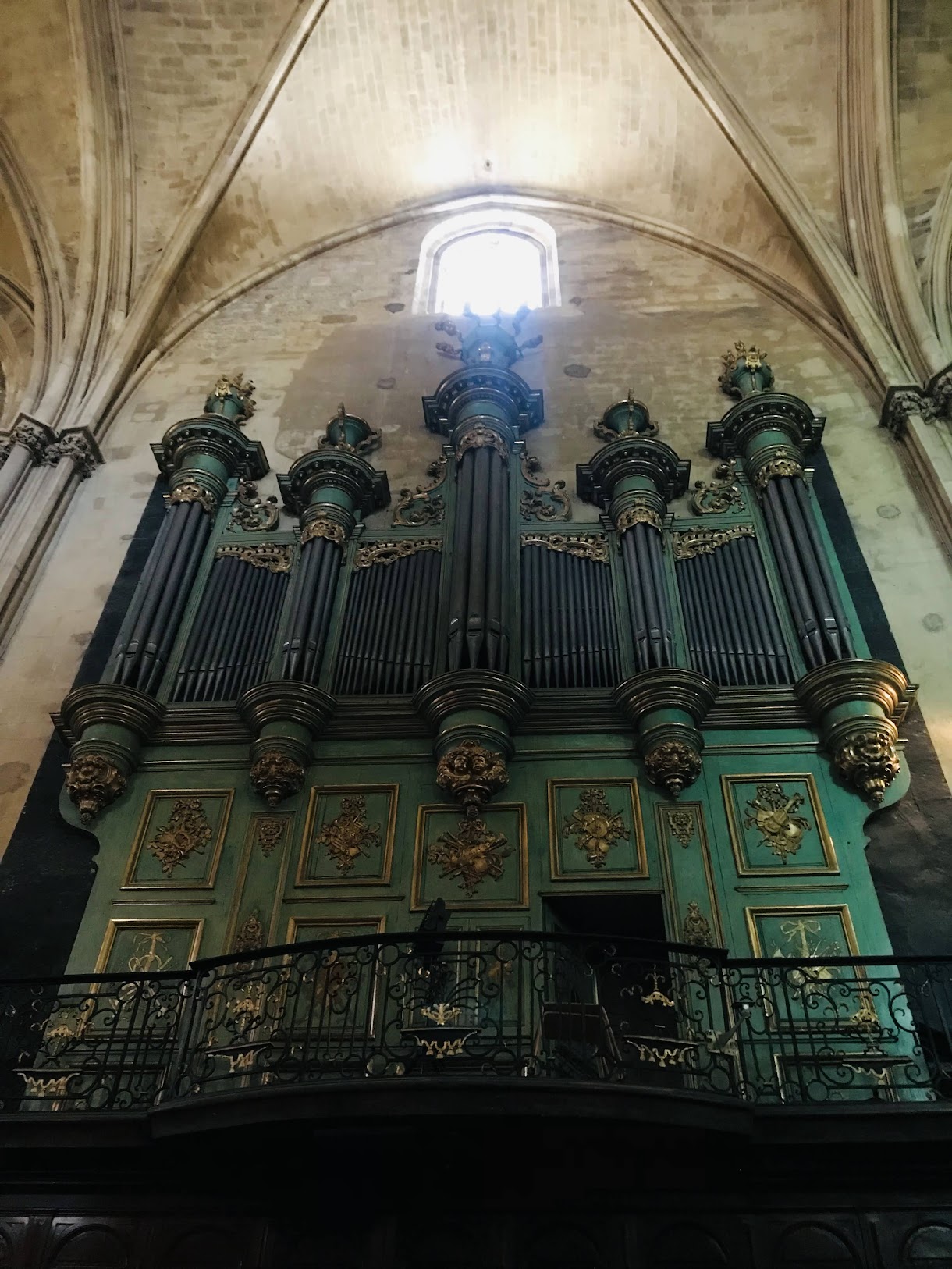


Over the last one year, I’ve started paying closer attention to church organs. I walk in, and turn my back to the altar that draws everybody, and spend a large majority of my time in the church studying the organ: from its size and complexity (the number of pipes) to its design and construction. Some boast elaborate facades adorned with carvings and sculptures, while others maintain a simpler aesthetic. In some churches, the organ can also be a historical artifact in itself. It’s a subject about which I don’t know much at all and I wish I could devote more time studying it.
Of all the organs I’ve admired, the one in the Cathédrale Saint-Jean-Baptiste in Perpignan is the one that fascinated me the most. Designed and built in 1875 by the renowned organ builder Aristide Cavaillé-Coll, it is a remarkable instrument. At nearly 20 meters tall, it is a giant, and dominates the space with its imposing facade. Unlike many organs, its pipes are not fully encased, offering a glimpse into the intricate network of gleaming metal that forms its voice. This unique design, showcasing the artistry behind the instrument, is further complemented by the most captivating sculpture – a Moorish head – suspended from the console.
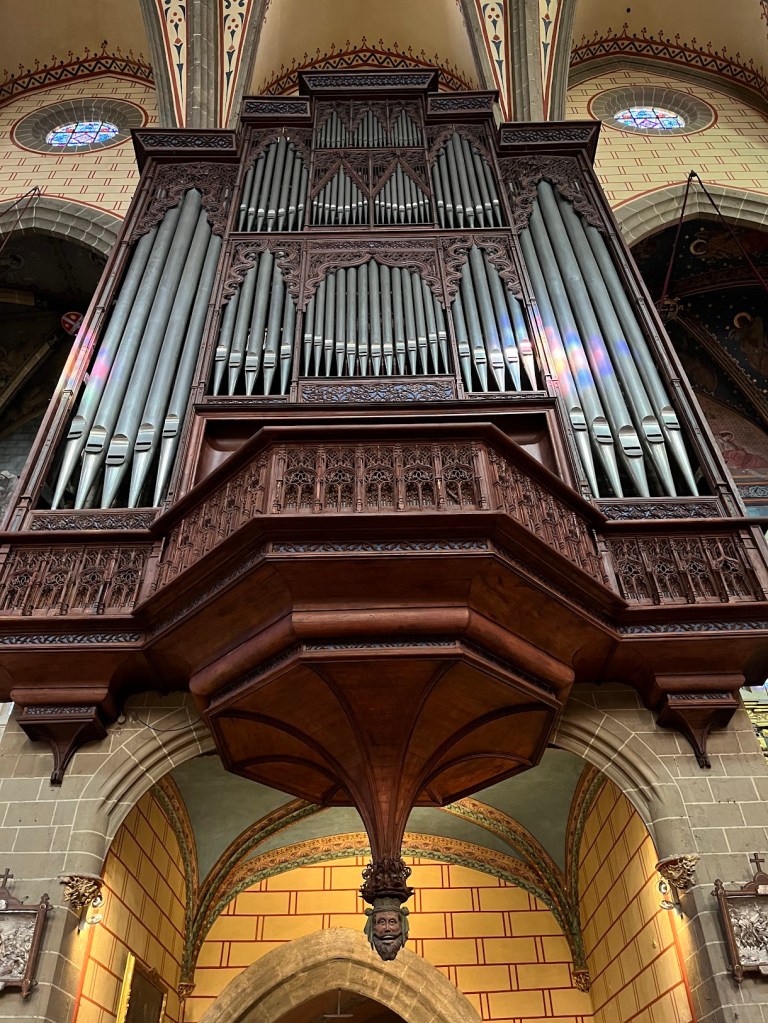
If the size of the instrument had me enthralled, I found myself even more drawn to the Moorish head. What was its significance? Was it merely a decorative element, or did it have a historical significance? Perhaps a nod to the Moorish rule in the region during the Middle Ages? Or something else?
I do believe it was the first time I didn’t find myself rushing out of a church, and actually wanted to linger, and maybe even return for a concert (despite the fact that it will most likely be religious in nature)! It’s true, I guess, music does have a divine power! 😉
 PlainGeets
Leave a comment