Tourism in summer in Europe makes everyone think of crowded beaches, bustling cultural sites, and a vibrant nightlife. It is that, but these days, it also means dealing with extreme heat. On a recent trip to Budapest, we found ourselves in the middle of a heat wave and struggling to do any kind of outdoor activities. Since walking through the streets was almost impossible, we did the next best thing – we hopped into the Hungarian National Gallery, not entirely sure what to expect. Like many of us, I grew up with the canon of European art history: France as the unquestioned capital of Impressionism, Italy as the cradle of the Renaissance, the Dutch Golden Age as its own well-documented chapter. But what happens when you step outside this tightly bound narrative? For me, the discovery was revelatory, and a window into what the Hungarians themselves call the “Budapest Eye.”
One of the artists who most stayed with me was Pál Szinyei Merse (1845–1920). I lingered in front of his Picnic in May (1873) for a very long time, marveling at the similarities with other known works.
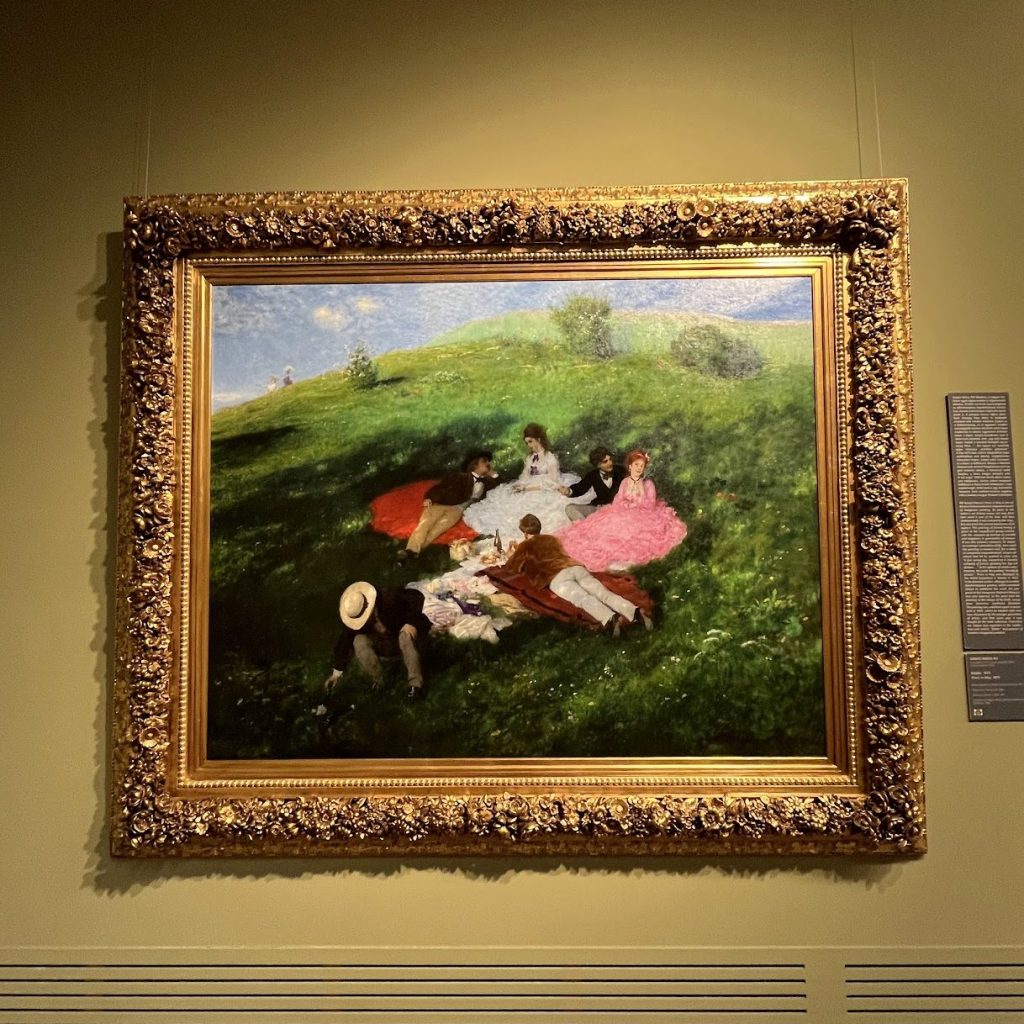
The canvas burst with light and colour: friends sprawled on a blanket in a meadow, dappled in sunshine, their clothes glowing in tones so modern they could have belonged to Monet or Renoir. The treatment of light, the fleeting quality of the scene, the almost radical celebration of leisure – all hallmarks of French Impressionism.
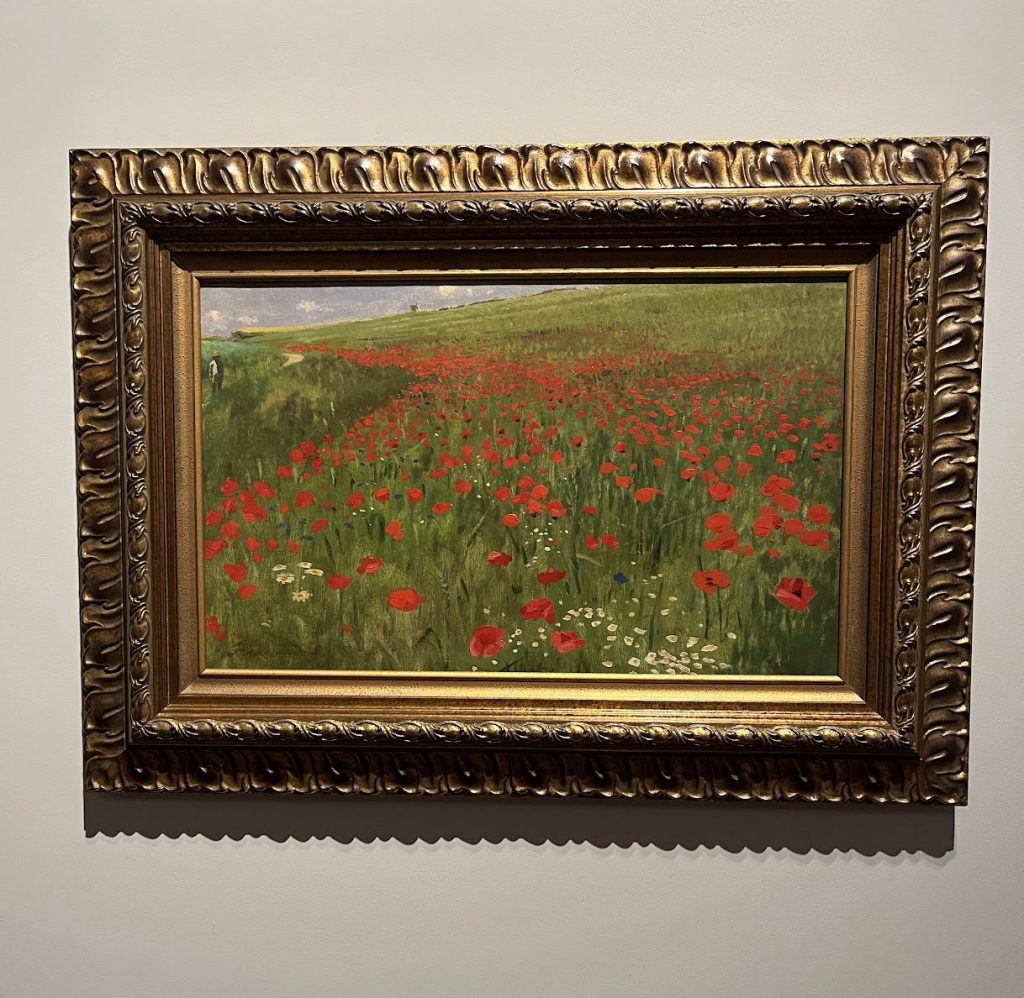
And yet, Szinyei never met Monet, Renoir, or Pissarro. He was working in near-parallel, geographically and culturally distant from the cafés of Montmartre and the exhibitions at the Salon. His brushstrokes, however, told the same story of modernity: of people suddenly untethered from rigid traditions, of light as a subject in itself, of fleetingness captured on canvas…and even fields of poppies!

That synchronicity shook me. We so often credit France with “inventing” Impressionism – a group of painters storming the Salon in 1874 and rewriting the story of art. But Szinyei, painting in relative obscurity in Hungary, was doing something strikingly similar, at the same time.
Why haven’t we heard of him? Why isn’t he celebrated as much as Monet and Renoir?
The more I thought about it, the more unsettling it became. Why had I, someone who has a keen interest in art history, and particularly Impressionism, never once encountered Szinyei in any anthology of “world art”?
The answer lies less in their talent and more in the geopolitics of culture.
Art history, like history itself, is written by the victors. And in the 19th century, France was the cultural victor par excellence. Its academies, its museums, and later, its critics and collectors dominated the narrative. A Hungarian painter, no matter how innovative, couldn’t hope to command the same attention as his Parisian counterparts.
This cultural hegemony has ensured that artists outside the Western “centres” are treated as peripheral, their work framed as derivative or secondary, even when it was independent, original, or in some cases, pioneering.
The realisation at Budapest wasn’t just about Szinyei. Over the last few months, I have been more and more aware of how skewed the canon truly is. We laud the Impressionists for their daring, and rightfully so. But to what extent have they overshadowed equally talented contemporaries elsewhere?
Take India, for example. No standard art anthology ever includes Indian artists in the same breath as the “world’s greatest.” At best, they are relegated to a separate category: “Indian Art,” “Oriental Art,” “Traditional Arts of Asia.” They are not permitted entry into the “mainstream” story of modern art, which remains stubbornly Eurocentric.
And yet, in 19th-century Bengal, artists of the Bengal School were experimenting with new forms, blending Indian aesthetics with modernist influences. Abanindranath Tagore, for instance, was in dialogue with Japanese artists and developing what could be seen as an Asian counterpoint to Western modernism. But because he wasn’t in Paris or London, his name never became part of the shared cultural consciousness in the same way as Cézanne or Gauguin.
The problem is not the lack of innovation, it is the lack of recognition. This is not accidental. The infrastructure of art – museums, galleries, critical journals, collectors, and eventually art historians – was firmly located in Western Europe and later the United States. They set the agenda. What was exhibited in Paris became what was seen, and what was seen became what was written about. The rest, as far as the canon was concerned, did not exist.
Think of it this way: if Szinyei had managed to get his Picnic in May displayed at the Salon of 1874 alongside Monet’s Impression, Sunrise, art history textbooks might read very differently today. But because he didn’t, he became a footnote (if that) while his French counterparts became headlines.
Another thing that intrigued me was the concept of the “Budapest Eye” — a painterly language also referred to as “Techno-realism.” According to a placard describing Szinyei’s work Skylark, this was a style defined by a certain optimism at the turn of the millennium. Adrián Kupcsik, whose work (left) was part of a contemporary series dedicated to and inspired by Szinyei’s work (right) explained that this language represented a unique, though brief, flowering of Hungarian art — an effort to capture the spirit of modern life with precision and vitality.

Curiously, when I tried to look up the “Budapest Eye” or “Techno-realism” afterward, I found almost nothing online. No articles, no art-historical discussions, no textbooks that recognized it as a movement. My only reference remains that placard in the gallery…a fragment of text that suddenly felt like a window into a forgotten or barely acknowledged chapter of art history.
That absence is telling. If a style or movement has left behind so little trace, it is not necessarily because it lacked merit. More often, it is because the machinery of art history (critics, museums, publishers, and curators) did not preserve it, did not write it into the canon. Once again, we see how fragile cultural memory is, and how much it depends on the infrastructure of recognition.
Walking through the Hungarian National Gallery, I found myself both exhilarated and a little angry. Exhilarated, because I was seeing beauty that had been denied to me by the limitations of the canon. Angry, because I realised how many other Szinyeis must exist in Poland, in Brazil, in India, in Africa. Artists whose work paralleled, anticipated, or even surpassed the celebrated movements of the West, but who never got their due because the story was being written elsewhere.
This imbalance isn’t just historical. Even today, global exhibitions still tend to reinforce hierarchies, even when they gesture towards inclusivity. “Peripheral” artists are included as exotic supplements, rather than as equal participants in the story of modernity.
The solution, of course, is not to diminish Monet or Renoir or Cézanne — their work remains transformative. But it is to widen our gaze. To allow for the possibility that artistic genius is not the monopoly of one city, one country, or one hemisphere. To ask uncomfortable questions about why certain names became canonical and others did not.
In some ways, Szinyei’s absence from the canon mirrors the absence of Indian artists from global anthologies. It reveals that the story we are told is less about art itself and more about power: who had the means to broadcast their art, who had the institutions to preserve it, who had the critics to legitimise it.
As I left the gallery, I was acutely aware of how much remains invisible, how much of the “world” is erased from “world art.” It was a reminder to myself that the canon is not neutral. It is curated, shaped, and in many ways distorted by cultural hierarchies. If we truly want to appreciate art in all its richness, we must look beyond Paris, beyond New York, beyond the familiar names in the textbooks.
Because somewhere in Budapest, or Bengal, or elsewhere still, there are brushstrokes waiting to be seen – brushstrokes that deserve their place in the world’s collective eye.
 PlainGeets
Leave a comment