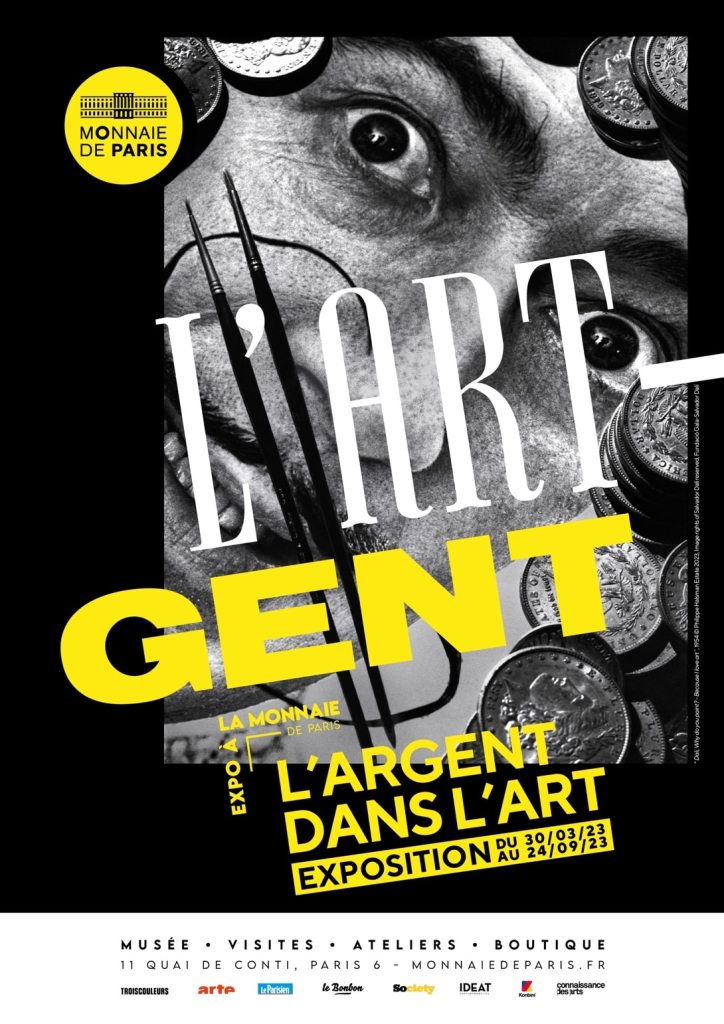
It was Salvador Dali’s face in the long, winding corridors of the Parisian metro stations that called out to me, before the title of the exhibition, “L’argent dans l’art.” The curation of 200 works of art not only brings forth the representation of money in art, but also addresses the very fundamental question of the value of art and its commercialisation.
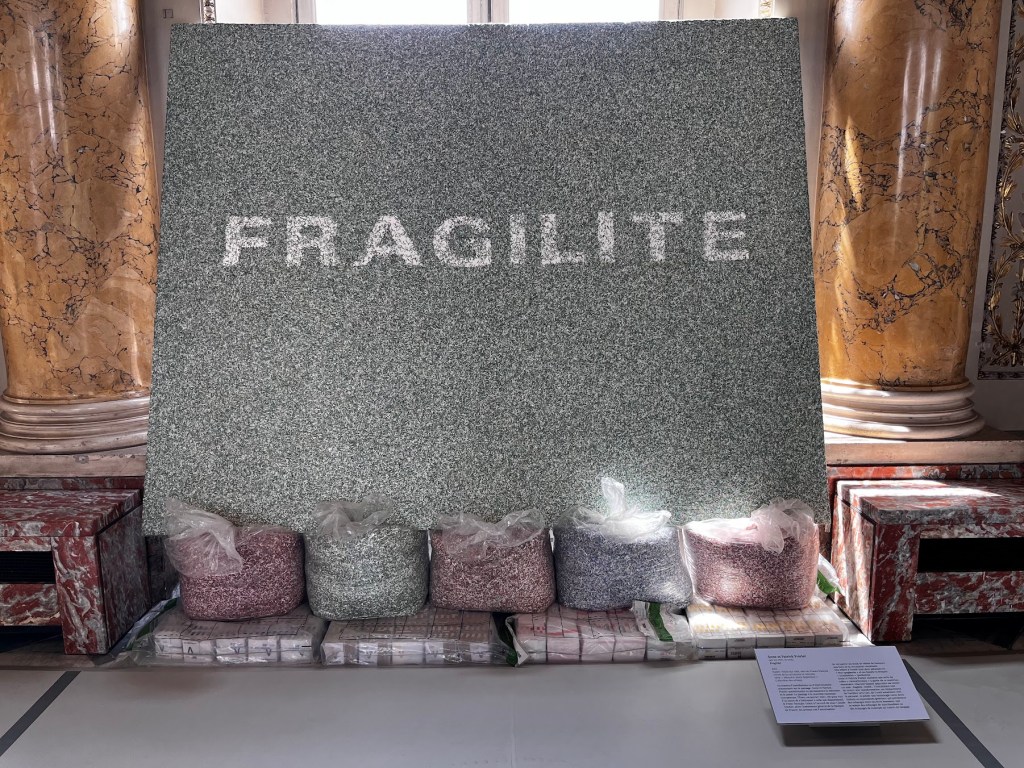
Organised by the Monnaie de Paris, the curation begins with very smartly chosen pieces that set the stage for the rest of the exhibition, by making the viewer think of the close relation between money and art. From the very thought provoking “Fragilité,” an oeuvre d’art composed of old banknotes of francs by Anne and Patrick Poirier, and Warhol’s “Dollar Sign” to Tracey Emin’s “I’ve got it all,” a Polaroid snapshot of the artist gathering a pile of British currency that seems to spew uncontrollably from her loins, the viewer can’t help but start questioning position of money in our lives.


The high point of the exhibition was coming across Manet’s “Asperge,” a story I loved sharing with students (thank you, dear Alter Ego 3 -IYKYK) about how the artist made a painting of a single asparagus when his client had rewarded him more handsomely than decided for a painting of a bunch of asparagus, saying “There was an asparagus missing in your bunch.” A lovely gesture which turned a very commercial relation into something of wit, warmth and elegance. On that note, did you know that the Impressionist movement was a byproduct of capitalism, and the desire of the bourgeois and nouveau riche to acquire art that they could display in their homes as proof of their finer tastes and class, signaling that “they have arrived”?
But the work that made the biggest impression, and left me mulling over a topic that is making me increasingly aware of, and uncomfortable about acquiring new things, was Barbara Kruger’s “I shop, therefore I am.” A spin on Descartes’ famous “I think, therefore I am,” the work is a powerful comment on a society that places greater value on material possessions, than intellectual pursuits.

Long after we had finished the entire parcours, I kept going back to Kruger’s work. Why do we shop? From satisfying our basic needs of essential goods and services and fulfilling our desires for enjoyment and self-expression, to serving as a form of therapy or stress relief, offering temporary comfort and a sense of control in a world full of choices, there is no dearth of reasons to let go of those purse strings. But how much of what we acquire do we need? And while we are on this acquisition spree, how often (or how much) should we consider the impact on the world – the consequences of the non-stop production of goods and normalised obsolescence of products on the environment, unequal access to goods, fair price policies…with each passing year, I find myself weighing these factors more and more, and find myself hesitating and rethinking almost every purchase, especially when it comes to clothes.
Do I really need another pair of jeans? Will an extra pair of jeans add value to my life? Where were these jeans made? Did the brand follow sustainable practices?
I am painfully aware of the real cost of fashion and all the myriad small objects that have flooded the market under the pretext of making our lives better. It’s the season of summer sales everywhere, and every time I see someone walking down the street with arms full of shopping bags, or see the crowds spilling out of stores, I can’t help but think of Kruger’s bold statement, and its significance, with Shania Twain running on a loop in my head:
We live in a greedy little world,
That teaches every little boy and girl
To earn as much as they can possibly,
Then turn around and spend it foolishly,
We’ve created us a credit card mess.
We spend the money that we don’t possess.
Our religion is to go and blow it all,
So it’s shopping every Sunday at the mall.
All we ever want is more,
A lot more than we had before.
So take me to the nearest store…Can you hear it ring?
– Ka-ching, 2003
It makes you want to sing,
It’s such a beautiful thing, ka-ching…
Lots of diamond rings,
The happiness it brings,
You’ll live like a king,
With lots of money and things…
Shania hit the nail on the head, didn’t she? The need to fit in and conform to the latest trends is driving us to an endless acquisition spree, and we are more concerned about updating our wardrobes and our gadgets, than cultivating our minds with cultural and intellectual pursuits. The problem is much more prominent among women, who are under a greater pressure to conform to trends, and whose image is largely defined by the norms and expectations of a patriarchal society. Kruger’s anti-consumerist oeuvre highlights the acceleration in the move towards a highly superficial society. What does it say about our society, when we are no longer defined by our thoughts, but by our possessions? And where will this lead us…?
 PlainGeets
Leave a comment