
Generative AI has been bringing shaking up the world of education for over a year now, and the turbulence is only about to get more aggressive with the constant developments in the space. In the wake of the OpenAI’s recent announcement about ChatGPT Edu, the London School of Economics talked about the growing need for customised AI solutions for Universities and the different categories of universities and how they are approaching AI. There are innovators, stewards, and the hmm crew (those who are undecided).
As an educator, the article struck a chord in me since the parallels between the institute and its people are many. Educators, the backbone of this shift towards AI integration in teaching, can also be categorised into three groups based on how they adopt this technology: innovators, stewards, and the undecided. Each group approaches generative AI in unique ways, shaping the future of education.
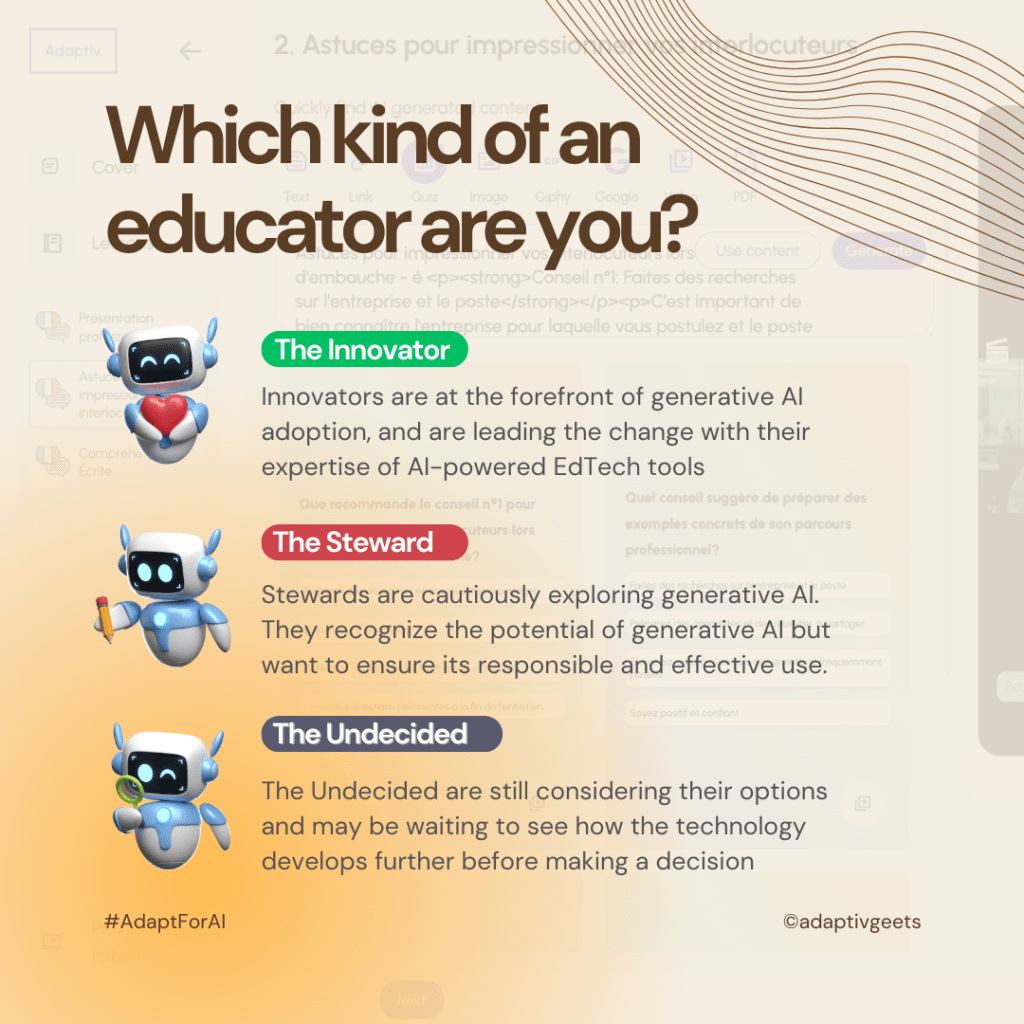
Innovators: Leading the Charge
Innovators are the trailblazers in the education sector. They are not just using Generative AI; they are also working with technologists to develop custom solutions tailored to their specific needs. These educators see AI more than a content generation tool. For them Generative AI is a technology that can enhance creativity, personalise learning, and streamline administrative tasks.
For instance, some innovators are creating AI-driven tutoring systems that provide personalised feedback to students. These systems can analyse a student’s performance, identify areas where they struggle, and offer targeted exercises to help them improve. This level of personalisation was hard to achieve before the advent of AI.
Others are using AI to develop custom educational content. By tapping to AI’s ability to analyse large datasets of student interactions and learning patterns, these educators can create materials that are more engaging and effective. This not only improves learning outcomes but also keeps students more engaged.
One of the most exciting aspects of being an innovator is the freedom to experiment. Innovators are constantly testing new ideas and pushing the boundaries of what is possible with AI in education. This spirit of innovation is crucial for driving the sector forward.
Stewards: Guiding Institutional Change
While innovators focus on creating and experimenting, stewards take a broader view. They are responsible for exploring institution-wide adoption of generative AI. Stewards are often in leadership roles, such as school administrators or district leaders. Their task is to ensure that the integration of AI aligns with the institution’s goals and values.
Stewards face a different set of challenges compared to innovators. They must consider factors like cost, scalability, and the impact on both students and staff. For example, implementing an AI-driven system across an entire school district requires careful planning and significant resources. Stewards need to make sure that the technology is accessible to all students, regardless of their socioeconomic background.
More often than not, stewards are also tasked with addressing concerns about privacy and data security. With AI systems collecting vast amounts of data, it is crucial to have robust measures in place to protect student information. This involves working closely with technology providers, legal experts, and educators to develop policies that safeguard privacy without stifling innovation.
Despite these challenges, many stewards are making significant progress. They are piloting AI programs in select schools, gathering feedback, and making data-driven decisions about scaling up. By taking a measured and strategic approach, stewards are laying the groundwork for widespread AI adoption in education.
The Undecided: Watching and Waiting
The third group, the undecided, is composed of educators who are either waiting to see how AI develops or are considering their options. This group is diverse, ranging from teachers who are curious but cautious, to administrators who are overwhelmed by the rapid pace of technological change.
One common reason for hesitation among the undecided is a lack of understanding about how generative AI works and its potential benefits. For many, the idea of integrating advanced technology into their teaching practice is daunting. They worry about the learning curve, the time required to adapt, and whether the benefits will truly outweigh the costs.
Additionally, some educators are concerned about the ethical implications of AI in education. Questions about bias in AI algorithms, the potential for AI to replace human teachers, and the long-term effects on student development are all valid concerns that need to be addressed.
However, being undecided doesn’t mean being inactive. Many educators in this group are taking a wait-and-see approach, monitoring how AI is being used by innovators and stewards. They attend workshops, participate in discussions, and keep themselves informed about the latest developments. This cautious optimism allows them to make informed decisions when they are ready to adopt AI.
The adoption of Generative AI in education is not a one-size-fits-all process. Innovators, stewards, and the undecided all play a crucial role in this transformation. Innovators push the boundaries and demonstrate what is possible. Stewards provide the necessary oversight and ensure that AI integration is done thoughtfully and responsibly. The undecided keep the conversation grounded, raising important questions and ensuring that the rush towards AI doesn’t overlook key issues.
As Generative AI continues to evolve, the roles of these groups may shift. Innovators will likely keep pushing forward, stewards will expand their implementations, and the undecided will gradually find their place in this new landscape to shape the future of teaching and learning, making the most of the opportunities that AI presents while navigating its challenges with care and consideration.


Leave a Reply