
At the recent Caillebotte Painting Men exhibition at the Musée d’Orsay, I found myself drawn not just to the Impressionist techniques or even the Urban Realism he’s famous for, like in Paris Street; Rainy Day, but to a deeper message hidden in his work. The exhibition highlighted Caillebotte’s fascination with masculine forms and his depictions of men, from urban workers, men lounging on a balcony, sportsmen, and even intimate portraits of a male nude at his ‘toilette’. Standing in front of these paintings, I couldn’t help but think about the gaze and explore how Caillebotte’s work engages with gender in ways that feel remarkably modern.
At the heart of Caillebotte’s work, especially in his depictions of men, I perceived a subtle but powerful subversion of the traditional male gaze.
In order to understand this interpretation, let’s briefly return to John Berger’s influential concept of the “male gaze” from his 1972 book Ways of Seeing. Berger explains how visual culture, particularly in art, photography, and media, has historically presented women as objects to be looked at by men. This concept, based on the power dynamic between the viewer and the viewed, is central to understanding how we can subvert traditional gendered representations in art.
What exactly is the “Male Gaze”?
Traditionally, the male gaze objectifies women, presenting them as passive figures meant to be viewed through the lens of male desire, with their bodies and appearances prioritised over their inner lives or personal agency. This creates an implicit power imbalance, where the viewer—typically male—holds the power of looking, while the subject, usually female, becomes the object of that gaze. Such dynamics have reinforced gendered hierarchies, positioning women as existing primarily for the pleasure or approval of men. John Berger highlighted that this perspective has deep roots in Western art, where male artists often portrayed female subjects to cater to the tastes and desires of male patrons, further cementing the notion of women as objects to be admired and controlled through the act of looking.
Can this Male Gaze Be Subverted?
Yes, of course, and one key way to subvert the male gaze is through the female gaze, which shifts the focus to a female perspective, emphasising empathy, emotional complexity, and authenticity.
How Does Caillebotte’s Work Subvert the Male Gaze?
Let’s look at how Caillebotte’s exploration of masculinity in his paintings challenges traditional representations and potentially aligns with the subversion of the male gaze.
Intimacy and Vulnerability
Private, domestic Scenes: In paintings capturing men in moments of self-care, Caillebotte shows a side of masculinity that is rarely seen. The men in these intimate, domestic moments are depicted with a sense of vulnerability—far from the dominant, public figures often seen in traditional male representations. This focus on personal, private rituals is a radical shift from the usual objectification and power dynamics of the male gaze. All you need to do is compare this painting to Degas’ series of women seen bathing. A series that though beautiful, holds a strong element of voyeurism, and the male gaze.
Focus on the Everyday: Caillebotte’s emphasis on the mundane—private routines or quiet moments—provides an opportunity for the viewer to connect with the subject on a human level, not as an object of desire but as a person.

In these paintings, you see the man in a relaxed, lounging pose traditionally reserved for women, making the viewer question if the man has to always been seen ‘in action.’ This empathetic perspective aligns with the female gaze, which values emotional connection over objectification.
Object of the Gaze
Physicality and Strength: In works like Rowing or other depictions of physical labor and sports, Caillebotte celebrates the male body. However, he does not frame this physicality as an expression of dominance or superiority over others.
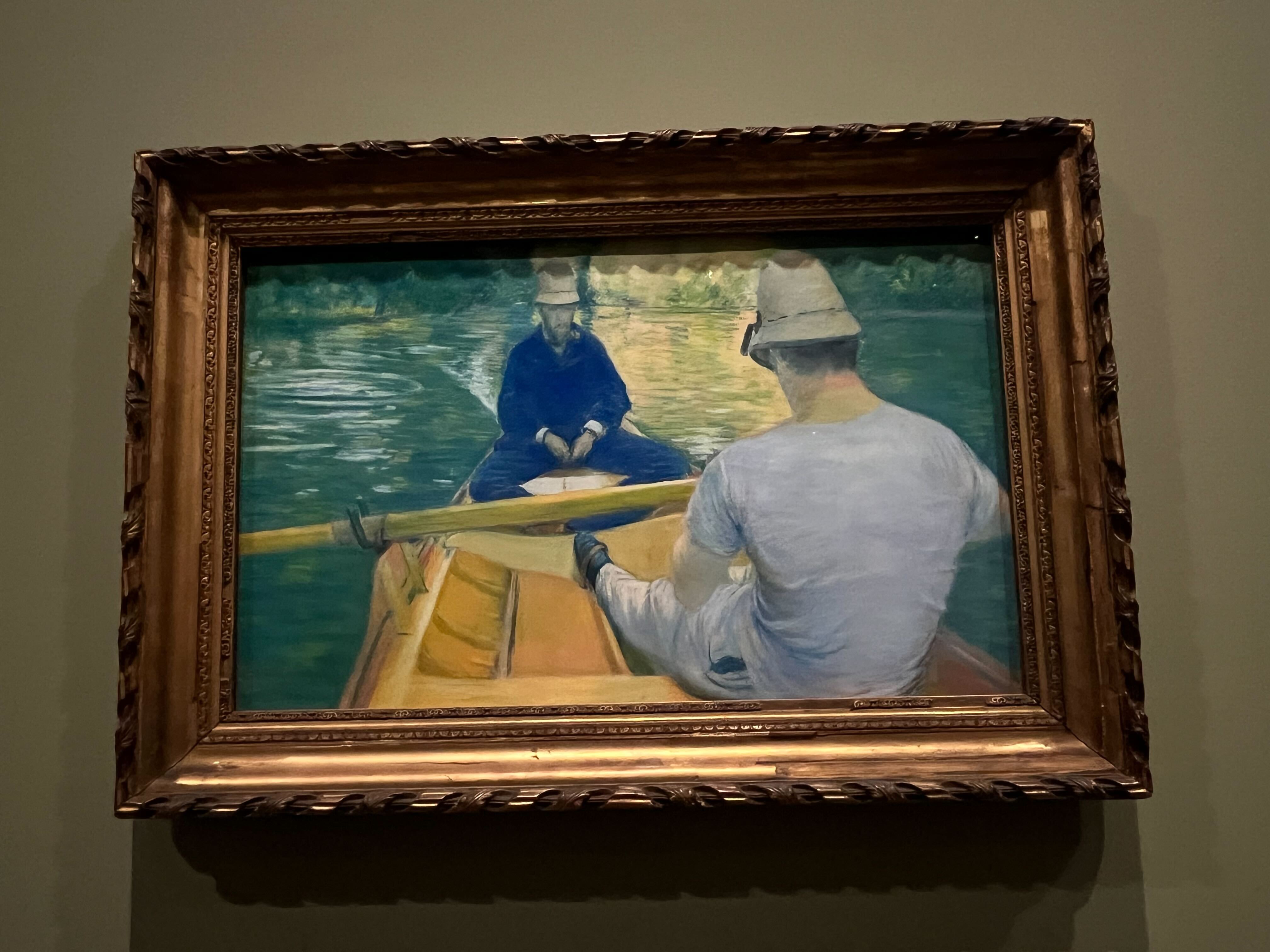

Rather than positioning the male form as a symbol of power to be controlled, he renders muscles and strength with admiration, allowing the viewer to appreciate male beauty without the gaze being tied to conquest or control.
Dandy Aesthetic: Caillebotte’s paintings of dandies—refined, fashionable men—suggest a kind of masculinity that is introspective and aesthetically complex. The man you see here for instance, with his carefully cultivated appearance, challenges traditional notions of masculinity.

This introspective, almost performative beauty resonates with qualities typically associated with the female gaze, such as attention to self-presentation, aesthetic sensibility, and emotional depth.
Blurring of Traditional Gender Norms
Fluid Masculinity: One of the most striking aspects of Caillebotte’s male figures is their fluidity. His men are not confined to a singular, stereotypical representation of masculinity. Instead, they embody a more complex, multidimensional form of masculinity, one that transcends the traditional boundaries of masculine and feminine.
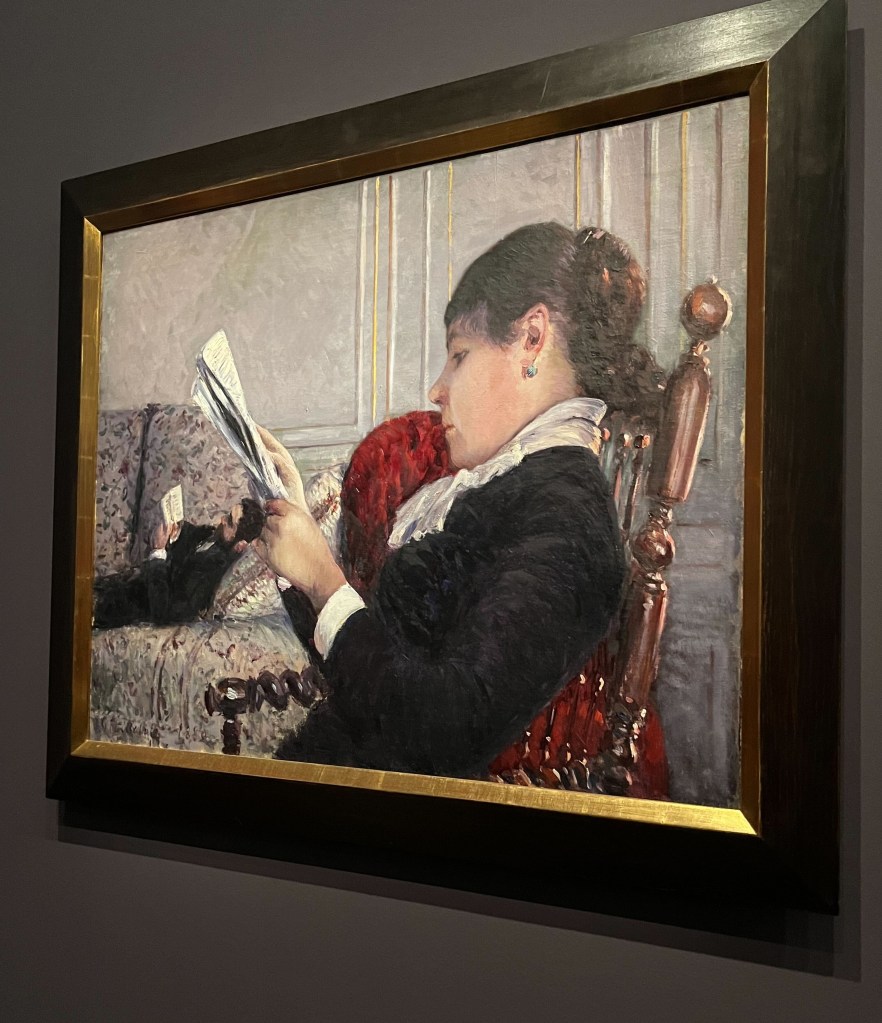
In this painting, we see the man lying back in repose, perhaps reading a novel, while the woman occupies the forefront and is reading a newspaper. This blurring of gender norms creates space for the appreciation of masculinity as both aesthetic and emotional, without the rigid constraints of gender expectations. This opens up a broader, more inclusive view of identity and representation.
Invitation for Empathy
Shifting the Viewer’s Role: Caillebotte invites the viewer to look at his male subjects not as symbols of power, but as complex, introspective individuals. His portrayal of men with sensitivity, especially in moments of vulnerability or personal expression, encourages empathy rather than objectification. This shift from dominance to understanding is a defining characteristic of the female gaze, which seeks to foster emotional resonance and connection rather than simply viewing bodies as objects of desire or power.
So, is it the Female Gaze?
While Caillebotte’s work may not fully align with the “female gaze” as we understand it today, it undeniably challenges the conventions of the male gaze. His nuanced portrayal of men—emphasising intimacy, physical beauty, and emotional depth—offers a fresh perspective on masculinity. Rather than presenting men as distant, dominant figures, he humanised them, revealing their complexity and vulnerability. In doing so, Caillebotte paved the way for a reimagined representation of masculinity, one that transcended traditional gendered expectations and opened space for a more empathetic, multifaceted view.
 PlainGeets
Leave a comment