
If there’s one thing uniting the entire country right now, it’s the collective delusion that Q-commerce is a blessing. Amazon Prime’s 24-hour delivery? Too slow for our dopamine-fueled impatience. We now demand instant gratification—as if waiting a few extra minutes for our overpriced coffee pods might trigger an existential crisis.
How did we get here? A little over a decade ago, BigBasket gently nudged us into the world of online grocery shopping. Soon after, Swiggy, Zomato, and Dunzo joined the party, enabling us to summon everything from vegetables to biryani with a few taps. By 2016, we were already quite devoted to this lifestyle of effortless consumption.

The pandemic sealed the deal. Locked indoors, we embraced delivery apps as our saviors, ordering our way through lockdown. What kept businesses afloat during those long months has now left an indelible mark on our psyche. Convenience became king, and we became its loyal subjects—conditioned to believe that waiting is an affront to modern life.
If Swiggy and Dunzo were already reshaping our habits before COVID, the post-pandemic scene now feels like a full-blown feeding frenzy. Enter Zepto—the new kid on the block—hailed as the world’s second most downloaded app in the food and drinks category (thank you, Sensor Tower, for tracking our descent into instant-consumption madness). Blinkit, its closest rival, snagged the tenth spot. And, of course, our old friends Zomato and Swiggy landed at fifth and ninth. A leaderboard of our collective impatience. Bravo!
In less than two decades, we’ve gone from a society that thrived on the local kirane ki dukaan to one that barely remembers what’s sold there. Why bother walking down the street when you can summon groceries faster than you can boil water? Weekly meal planning and shopping lists now seem as quaint as sending telegrams.
But this instant gratification comes at a cost—one we’re either too distracted or too lazy to notice. With quick-commerce apps relying on local dark stores (basically mini-warehouses lurking in our neighborhoods), our choices are increasingly dictated by what’s in stock within a 10-minute radius. Can’t find fresh basil? Settle for dried oregano. Need a specific brand of coffee? Better hope the algorithm deems it worthy of local storage. We sure didn’t get the coffee we needed.
Over time, we’re not just losing access to variety. We’re losing the ability to even notice its absence. Algorithms now shape our consumption habits, narrowing our world to what appears on a search bar. I stubbornly resisted downloading apps to save a few rupees or steps, only to discover that products I needed simply weren’t available on the new BigBasket Now…even when I requested a later delivery. Frustrated, I stepped outside to hunt for the item in a store (imagine that!), but how many people still bother? Most I spoke to said they simply adapt (read: compromise).
We’re not just outsourcing errands. We’re outsourcing engagement with the world. Every tap distances us further from the tactile, unpredictable richness of real life. The joy of discovering a new snack at the local store, the spontaneity of choosing fresh produce, the simple act of walking down the street- all fading into distant memories as we become consumers of convenience, stripped of curiosity and connection.
And then there’s the laziness factor—something even Piyush Goyal, Minister of Commerce and Industry, pointed out last year.
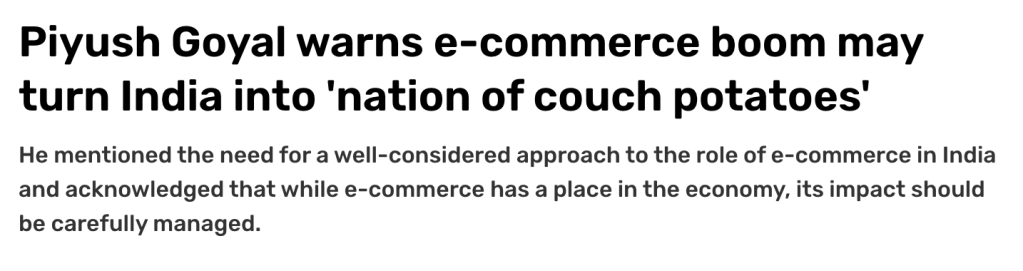
Why walk to the store or plan a grocery run when you can summon a packet of chips and a bottle of soda with a tap? At this rate, future generations might struggle to find their way to the kitchen, let alone a market.
Of course, we mustn’t forget the environmental aftermath…because instant gratification comes individually wrapped. Every single order arrives with its own guilt-inducing paper bag. Need a loaf of bread? One bag. Forgot the butter? Another bag. Craving ice cream? Yet another bag. At this rate, we’ll soon be buried under a pile of them. Every home I visit has stacks of paper bags cluttering their kitchens. Am I the only one getting worked up about this? We’ve swapped plastic for paper and patted ourselves on the back, ignoring the fact that deforestation is just as real as plastic pollution…and trash, at the end of the day is trash!
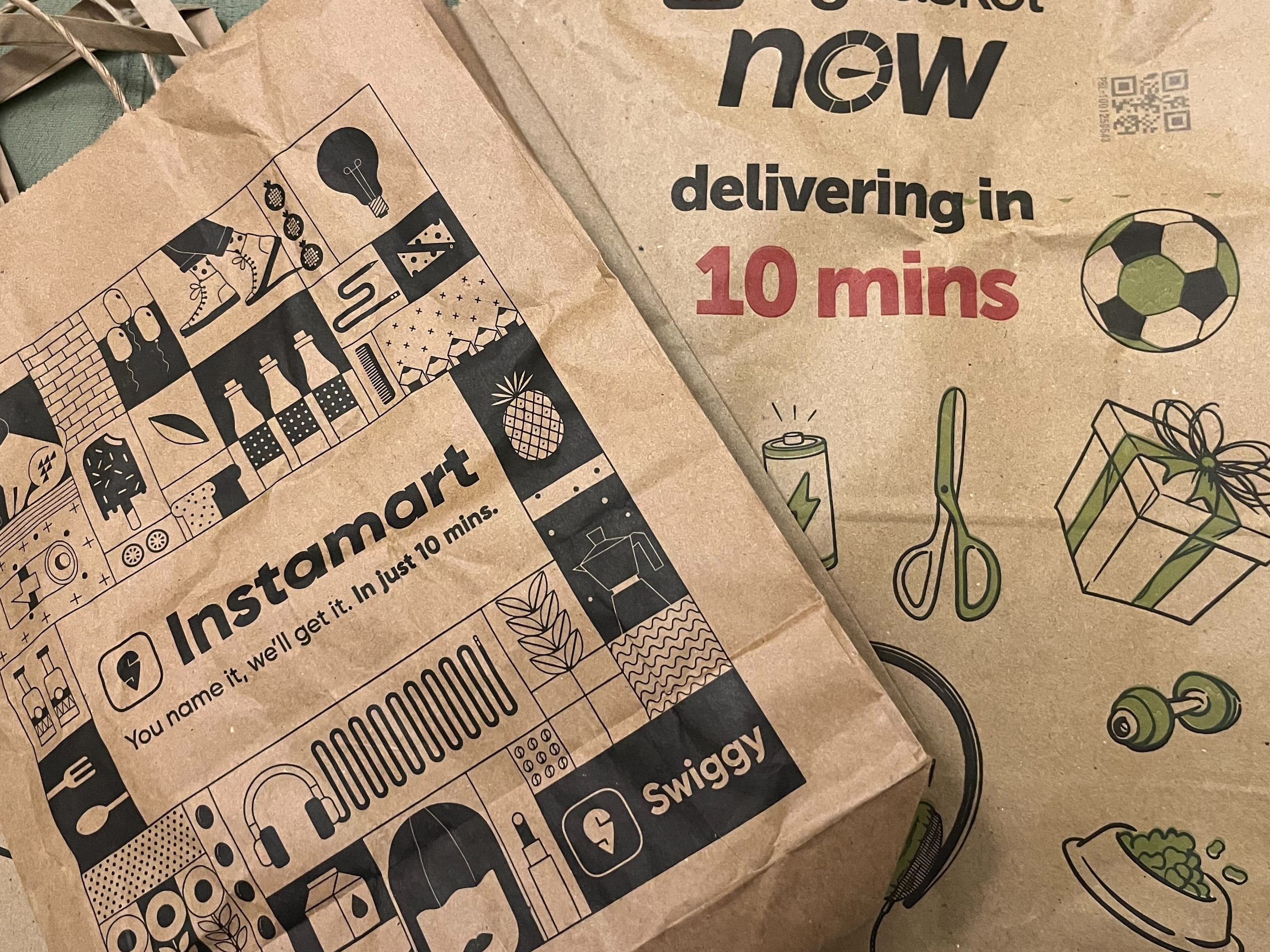
And let’s talk about what this rampant consumerism is doing to our sense of fulfilment. The more we consume, the emptier we seem to feel. Instant deliveries create a vicious cycle of fleeting pleasures – momentary dopamine hits that fade as quickly as they arrive. We’re becoming a nation of restless souls, forever chasing the next delivery, the next convenience, the next fix, without ever pausing to ask: Do I really need this?
But let’s face it—are we giving up these apps anytime soon? Of course not. Convenience is addictive. The question is: At what cost? When do we wake up and realise that this endless pursuit of speed and ease is eroding our social fabric, reducing us to passive consumers with shrinking worlds and hollow hearts?
Maybe – just maybe -it’s time to strike a balance. Plan a few meals. Rediscover what our local stores have to offer. And maybe even walk to the market once in a while. Who knows? We might even find fresh basil still exists beyond the algorithm’s reach.
After all, convenience is great, but so is knowing that life exists beyond an app’s search bar…and maybe saving the planet from a few extra paper bags along the way.
 PlainGeets
Leave a comment