My first visit to the Ajmer Government Museum was memorable for all the wrong reasons. It was the peak of summer, the museum was (and still is) undergoing restoration work, everything was covered in dust, and I was accompanied by two disinterested souls who desultorily traipsed through the galleries. Though parts of the collection excited and inspired me, my memories of that day are mostly of the heat and the dust.
Back for a second visit this weekend, in much better weather, I was finally able to appreciate the museum. But as in the case with any museum visit, there is one piece that has stayed back with me.
What was it about this painting that stayed with me?
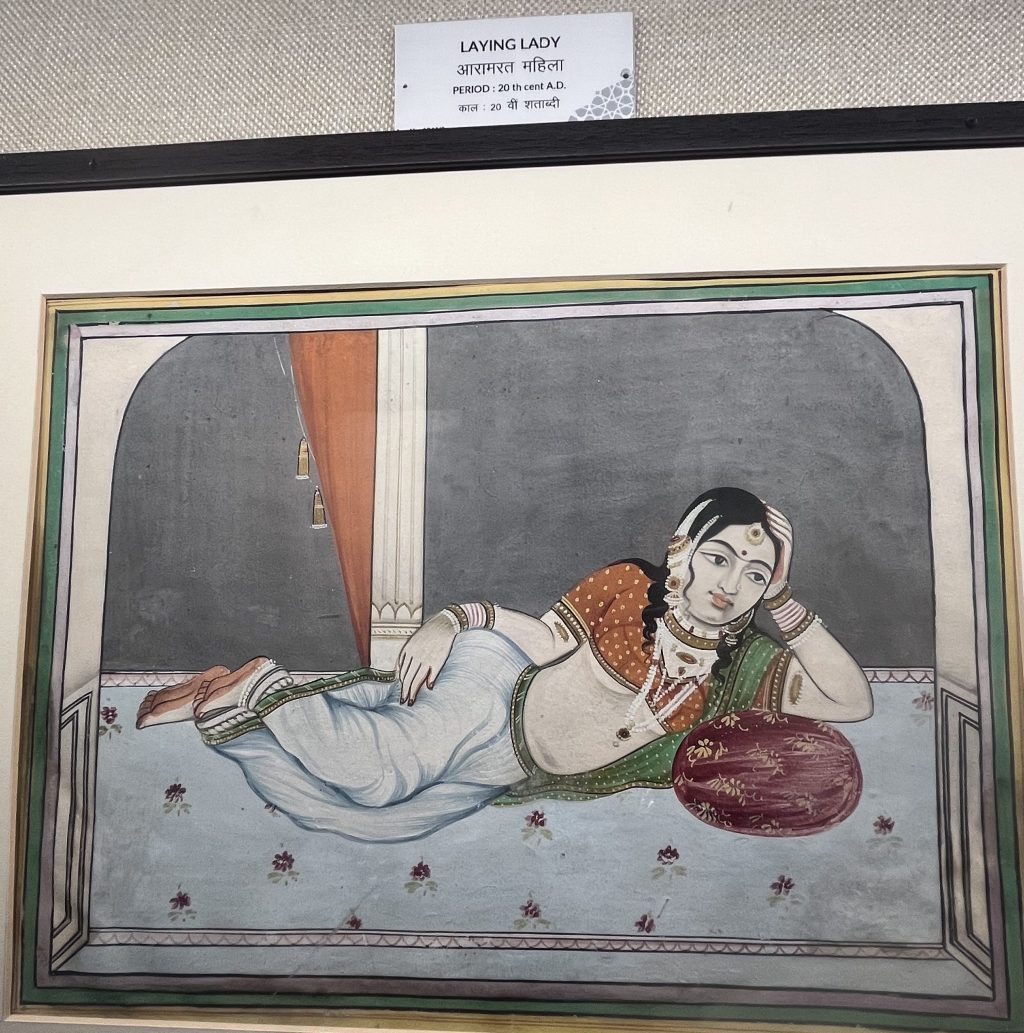
The painting is labelled Laying Lady.
That’s it. No date, no school, no speculation about who she might be or what tradition placed her here. Just a bureaucratic fact: there is a lady, and she is laying. The museum has catalogued her with the same descriptive enthusiasm one reserves for a chair.
And perhaps to most viewers, this is a very ordinary painting, one among the many other paintings, sculptures and objects that appear in museum rooms through the slow accumulation that happens when a state institution is the only place objects have to go. But it made me pause for two reasons – in a room filled with scenes from the Prithviraj Raso and Krishna Leela, this seemed rather incongruous. What made the curator choose this particular painting, over another depiction of Krishna Leela, or even one of the many princes of Rajputana?
The lady reclines on a pale blue floor scattered with small red flowers, her head propped on one hand, her gaze directed at nothing in particular, or at something very particular, somewhere entirely inside herself. She wears an orange choli, a green dupatta, a diaphanous white ghaghra that pools around her legs. Gold at her neck, her ears, her forehead. A dark braid falls across her shoulder. Behind her, a grey interior, an arched niche, a terracotta curtain hanging from a tassel. Beside her hip, a deep crimson bolster.
She is not posing. Or rather, she is in the pose of someone who doesn’t care that they are being painted.
A little research revealed that this is very likely a nayika painting. The nayika tradition, rooted in Sanskrit poetic theory and fully elaborated in texts like the Natyashastra and Rasamanjari, classified women by their emotional states – their relationship to love, longing, seasons, time of day. There were dozens of types. The vipralabdha nayika, deceived and abandoned. The khandita, who has waited all night and found the marks of another woman on her lover’s body. The abhisarika, who dresses and goes out to meet her lover against all social propriety, thunder and dark roads be damned. The utkanthita, who simply waits. And waits.
Our lady looks most like a Vasakasajja – the nayika who dresses in her finest, puts on her jewellery, perfumes her hair, and waits by the bed. Bhanudatta in the Rasamanjari describes her: she put on all her jewellery, perfumed her thick head of hair, and at her bedside had them place areca nut and betel leaf. Our Laying Lady has done exactly this. The gold is on, the hair is braided, the bolster is in place. She is ready, and waiting for her lover.
Though I didn’t know about the nayikas before our visit to the museum, the irony between the rather plain title, and the not-so-plain pose stayed with me through out the day.
But more naggingly, I couldn’t stop thinking about the parallels with Manet’s Olympia. In 1865, Manet created a scandal with a painting that showed a naked woman reclining on a couch, her gaze directed straight at the viewer – cool, direct, unreadable. A Black maid stood behind her, presenting flowers from a client. A black cat arched at her feet.
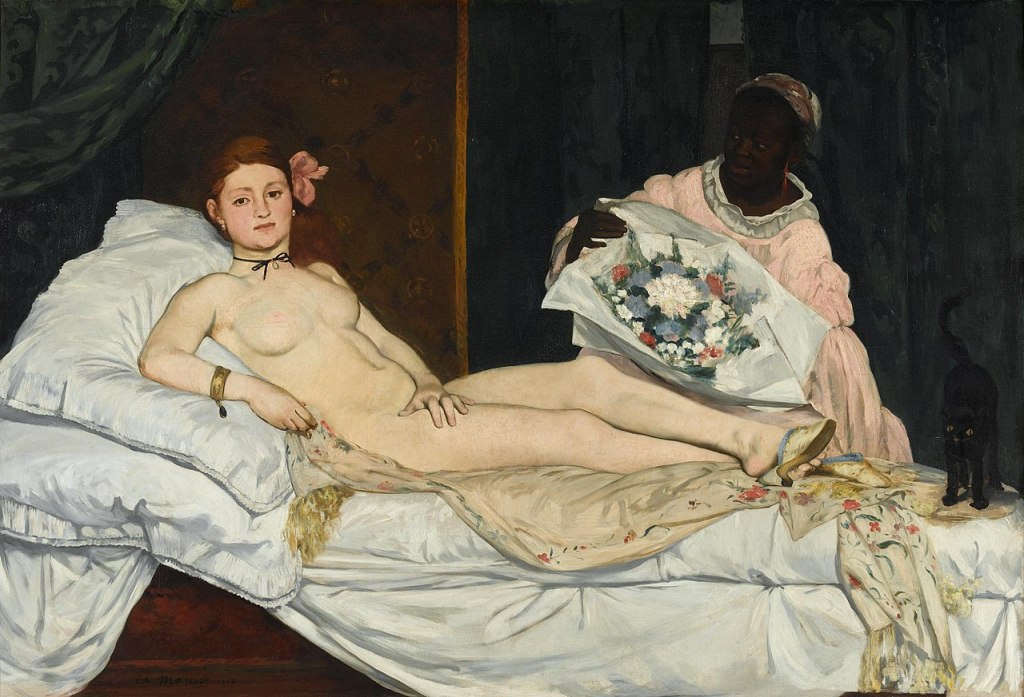
The scandal wasn’t that she was naked. The Salon was full of naked women. The scandal was that she looked back. The conventional nudes – Titian’s Venus of Urbino, Giorgione’s Sleeping Venus, Ingres’ Odalisque – all asked the viewer to look at them without being seen looking. The woman’s gaze was averted, or closed, or directed at something decorative and unthreatening. You could stand in front of the painting and be invisible. That was the arrangement.
But Olympia refused it. She looked directly at whoever was standing there, and her expression said: I see you. I know what this is. Do you?
Manet had painted a woman who knew she was being watched, and had decided to watch back.
The Laying Lady in Ajmer, however, does not look back.
More importantly, the tradition she comes from does not require her to.The nayika painting wasn’t made to be hung in a gallery where strangers would file past. It was made for a patron who understood the rasa framework, who would sit with the image in a particular way, as one sits with a poem. The viewer wasn’t a spectator. They were, in some sense, a participant in the emotional state – you didn’t look at the nayika, you were invited to feel with her. There is no transaction. There are no flowers from a client. There is no gaze returned, no confrontation, no knowingness directed outward. The interiority is the entire point.
This is where the comparison to Manet becomes interesting and then becomes complicated.
Olympia’s power is her refusal to be an object. She insists on her subjectivity by directing it at you, making you feel the discomfort of being seen seeing. It is a profoundly modern move – the self as a site of resistance, the gaze as a weapon pointed back.
But what do we make of a woman whose subjectivity was never structured around the viewer in the first place?
The Laying Lady isn’t refusing your gaze. She’s not even aware of it as something to refuse. She is elsewhere.
Modernity has taught us to recognise agency in confrontation – in the returned gaze, the refusal, the challenge. But what if there is another kind of presence altogether? One that neither invites nor rejects the viewer, because it is wholly occupied with its own interior world.
The Laying Lady does not look back. She simply remains, self-contained and unreachable. And perhaps that is why she stayed with me.


Leave a Reply