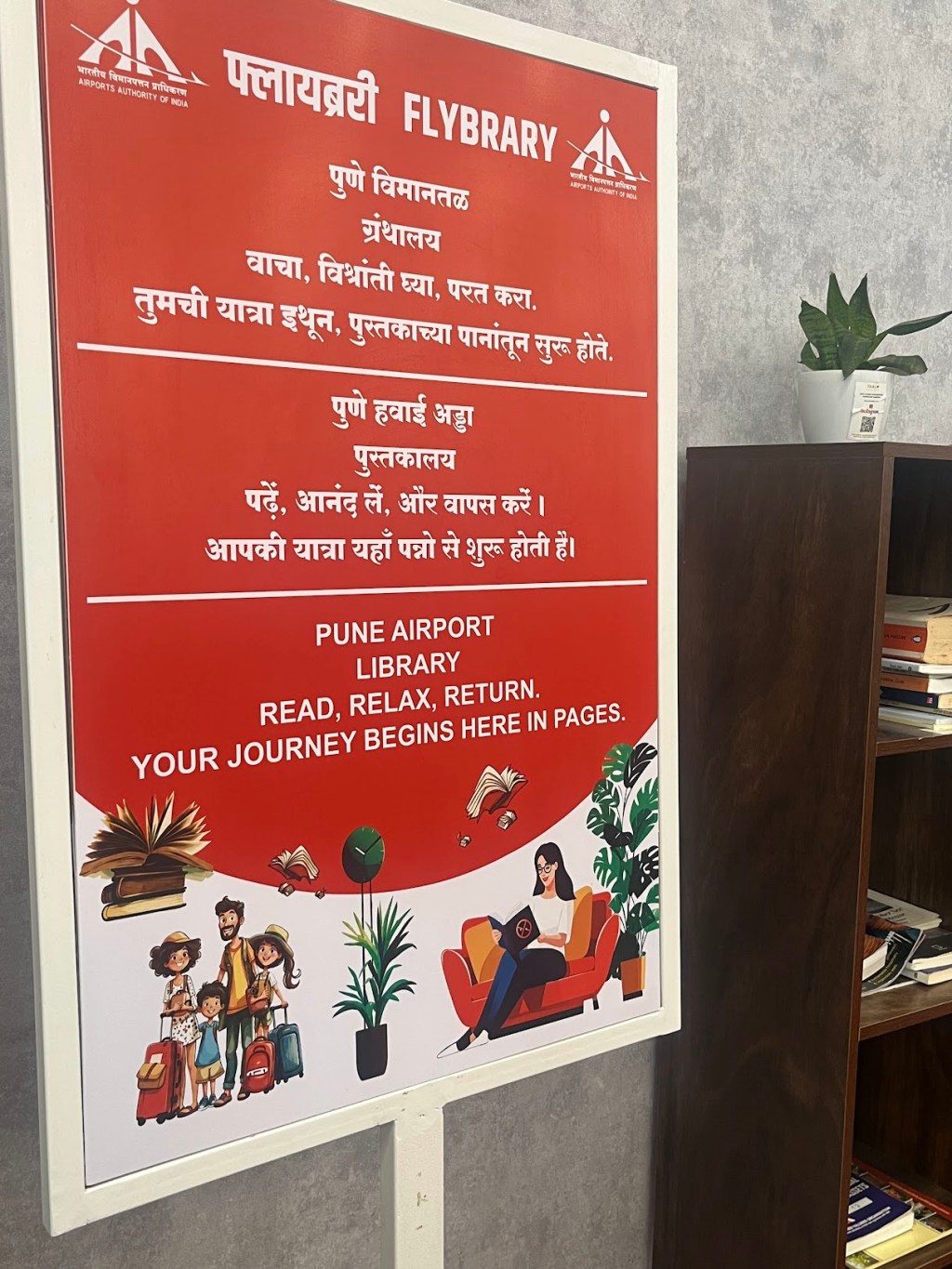
At Pune airport Terminal 2, past the security check, there’s a set of dark wood cube shelves standing under a cheerful yellow banner: Fly Beyond Destinations, Read Beyond Boundaries. Flybrary, it says — an initiative of the Airports Authority of India. Read while you fly, drop the book at your next destination.
It’s a genuinely good idea, and made me really happy, till I noticed that most of the shelves were empty.

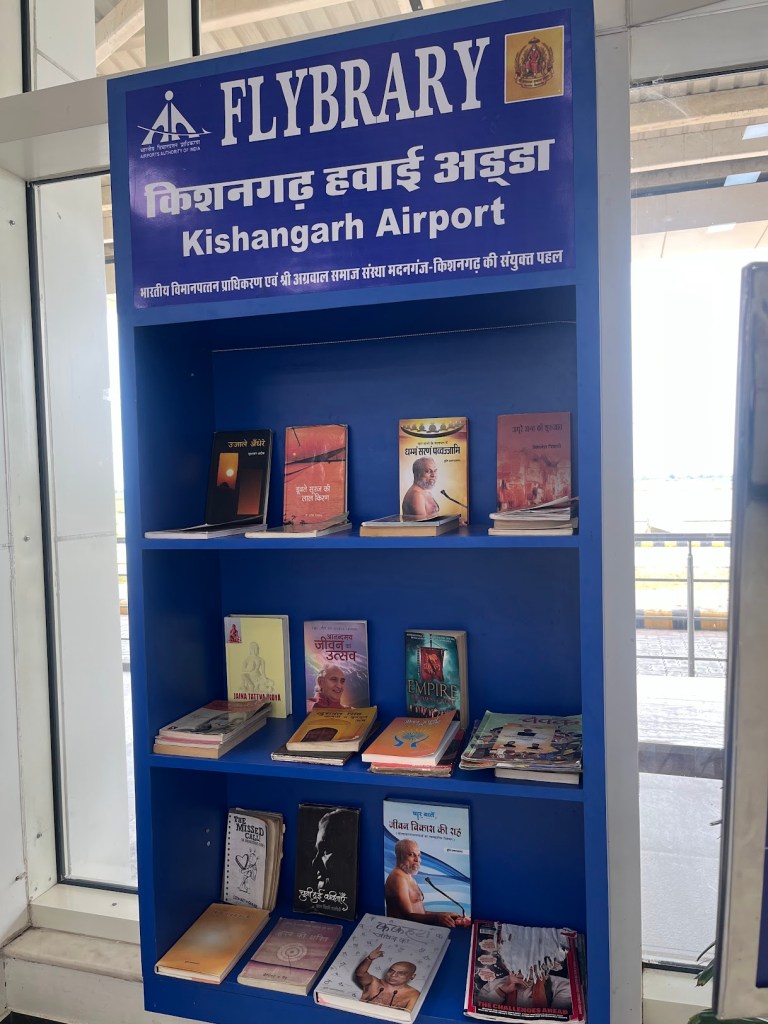
Not artfully empty, the way a minimalist bookstore display is empty. Actually empty — cube after cube with nothing in it, a stray paperback or a folded magazine here and there, no evident order, no sense that anyone chose what would sit where. A few days later, I encountered the Flybrary again – this time at the tiny Kishangarh airport, a little over a thousand kilometres away. The single blue shelf tells a more specific story: several book covers with a saffron-robed spiritual figure mid-address, a title on Jain philosophy, a handful of motivational paperbacks with titles about life’s purpose and inner victory, and one lone history book, Empire, sitting slightly out of place among them. A joint initiative, the sign explains, of the AAI and a local Agrawal community trust.
Flybrary started as a pilot at Bhubaneswar’s Biju Patnaik International Airport in February 2025, the brainchild of Sujit Mahapatra of the Bakul Foundation, working with the AAI. The model is close to frictionless: no membership card, no check-out counter, no due date. Take a book, read it at the gate or on the flight, drop it at a Flybrary at wherever you land next. In a little over a year, it scaled from one airport to sixty-eight, with the Civil Aviation Minister publicly cheering its expansion as part of a broader push to make airports more passenger-friendly.
As an idea, this is close to the best kind of public reading intervention India could design. It asks nothing of the passenger — no sign-up, no app, no trip to a library that isn’t already part of their day. It targets a genuinely dead pocket of time that every air traveller has and usually spends staring at a phone. It’s cheap to run relative to almost any other literacy or reading initiative, since the infrastructure — the terminal itself — already exists. If there is a single low-effort, high-reach lever available to a country trying to build a reading culture, an airport shelf that a bored, waiting stranger can browse without being asked to justify themselves is close to it.
Which is exactly why the shelf itself matters so much, and why it’s disappointing that nobody seems to have thought as hard about the books as they did about the banner.
Picture the two kinds of people who might stop at a Flybrary shelf. One is already a reader, mid-book, glancing over out of habit to see if something interesting is there. The other has forty minutes to kill, has already scrolled through everything on their phone, and is the exact person this initiative is supposed to be reaching — someone who doesn’t ordinarily read but might, if something on that shelf actually looked like it was worth their next forty minutes.
A half-empty cube of stray, mismatched paperbacks (and school textbooks) will lose the first kind of person out of sheer thinness of choice. It will lose the second kind of person before they even get that far — because a sparse, uninviting, oddly-skewed shelf doesn’t spark curiosity, it confirms the quiet assumption a lot of non-readers already carry: that reading is something other people do, a hobby with its own closed, slightly niche taste, and that whatever’s on offer probably isn’t for them. An airport shelf stacked mostly with donated spiritual and motivational titles from a single local trust isn’t wrong to exist — it’s just a startlingly narrow bet to be the entire offer at that airport, for every kind of traveller who might walk past it.
The tragedy is that the format could do exactly the opposite. A well-stocked, well-chosen shelf with genre balance, some regional-language titles, a few unmissable, high-appeal books facing outward is one of the few reading interventions that could plausibly convert a curious non-reader on contact, precisely because there’s no cost to trying: no purchase, no commitment, no membership. That conversion moment is sitting right there, and right now it’s being wasted on inventory that has been dumped there without any thought rather than by design.
This is the part of the idea I find myself genuinely excited about, and the part that makes the wasted shelf sting a little more than a simple stocking error should. Getting someone who doesn’t read to pick up a book on their own, without being assigned it or sold on it, is the hardest problem in the whole business of bringing reading back into people’s lives — and almost nothing else asks so little of a person at the exact moment they might be open to trying. Flybrary already has that moment built in, for free, at national scale, sixty-eight times over. Watching it sit half-stocked feels like someone left the front door open and forgot to turn the lights on.
After seeing these two examples of flybrarires, I just have a simple question:
The AAI runs the airports, and thus has the ministry’s public backing and, evidently, the appetite to expand this to 68 sites and counting. So what is preventing it to have a real and formal book-sourcing mechanism? I am not expecting the government to open its coffers – this is not a new terminal, a bridge, a school, or even a temple after all. But why are there no public call for donations, no stated curation criteria, no publisher partnerships, nothing beyond whichever local goodwill happens to show up at a given terminal. Kishangarh got the Agrawal Samaj Sanstha. Other airports presumably get whoever’s available there. That’s not a collection strategy. That’s whatever fell off the back of a cupboard.
This is solvable, and not expensively. It doesn’t need a new government scheme — it simply needs the AAI to promote Flybrary as a CSR channel so that the companies who are already looking for education and literacy projects to fund. have a very viable option, and to pair that funding with an actual curation standard rather than leaving stocking to chance.
And that standard doesn’t need to be complicated. A simple public call — publishers, corporate CSR desks, individual donors — with a stated genre spread, a floor on regional-language titles rather than a completely random and uninspiring dump, and a minimum stock level per shelf before an airport gets listed as “live,” would fix most of what’s visible in these photographs within a single sourcing cycle. None of that requires new infrastructure. It requires someone at the AAI deciding that the books are as much a part of this rollout as the banner announcing them.
There are two models already proving this works
Coforge’s public library CSR programme is the clearest domestic proof that this is achievable fast. Its first library opened in Noida in February 2024; by mid-2025 there was a second in Gurugram with over 16,000 books drawn from more than 13,000 authors and 350-plus publishers, spanning fiction, non-fiction, children’s literature, and regional-language titles; by October 2025 a third opened in Hyderabad spanning nearly 15,700 square feet; a fourth followed in Delhi in 2026. One company’s CSR budget, applied with actual curatorial intention, built four genuinely appealing, professionally stocked public libraries in roughly two years — longer than Flybrary’s own runway, but with a fraction of the reach and none of Flybrary’s built-in national footprint.
And on the curation question specifically, India already has an organisation that has spent two decades solving exactly this problem for children’s reading: Parag, the Tata Trusts initiative, which since 2005 has built the Parag Honour List — a rigorously jury-vetted annual selection of the best children’s books in English and Hindi, screened from hundreds of submissions each year — alongside a programme that has trained thousands of teachers as school and community librarians and reached more than twenty million young readers. Parag’s entire premise is that access alone doesn’t create readers; considered selection does. That’s precisely the layer missing from Flybrary right now.
Neither of these models is exotic or foreign. Both are Indian, both are already running, and both would say the same thing if asked to look at that Kishangarh shelf: this isn’t a funding problem, it’s a curation-and-partnership problem, and it has a known, workable fix.
None of this is an argument against Flybrary. It’s the opposite — the idea is good enough to be worth being properly annoyed about its execution. A national airport network with a near-zero-friction reading format, already scaled to 68 sites, already backed by the ministry, is a genuinely rare piece of soft infrastructure. Pair it with an open call for book donations, a partnership with an outfit that already knows how to curate at scale, and even a modest CSR allocation from any of the dozens of Indian companies currently looking for exactly this kind of visible, feel-good education project — and Flybrary stops being a well-meaning shelf with three stray paperbacks in it, and starts being something our country could actually be proud of showing a first-time flyer.


Leave a Reply